Since the 1970s, Izabella Gustowska has been one of the defining figures of conceptually oriented Polish art. Her work operates at the intersection of representations of the body, the construction of subjectivity, and feminist critiques of the image, exploring the conditions of visual perception as well as the cultural production of identity. As a professor at the University of the Arts in Poznań, she has influenced several generations of artists. She has gained international recognition through, among other things, her participation in the São Paulo Biennial (1983, 1987) and the Venice Biennale (1988).
For her presentation at KVOST, Gustowska is showing new works that engage with the themes of memory, identity, and temporality. The starting point is the family home in Poznań, where her family has lived since 1938 and which serves as both a biographical and cultural site of memory. The new works enter into dialogue with key works from the 1980s, created during her time at this location, enabling a retrospective examination of recurring motifs and questions within her oeuvre.
Gustowska explores the boundaries of her own identity through the reflection of the Other. A recurring interest in her work is the relationship between siblings, and in particular the special bonds between twins. The relationship between the self and its counterpart thus becomes a central motif in her artistic practice.
A central work in the exhibition is the video Home’s Shadows, a sentimental journey into the past and an attempt to trace the paths of childhood. This classical form of topophilia—the search for identity through space—is, in Gustowska’s understanding, a narrative about who she was and what became of that former “self.”
The rooms of the house appear to her as resonant spaces of former incarnations. An important source of inspiration for the film was also Paul Éluard’s poem Dans Paris, which describes a place through a sequence of nested spaces: Paris with its street, the house, the staircase, the room, the table, the tablecloth, the cage, the nest, the egg and the bird. Similarly, various elements appear in Gustowska’s video, including a table and fantastical birds that transform the garden into a magical place.
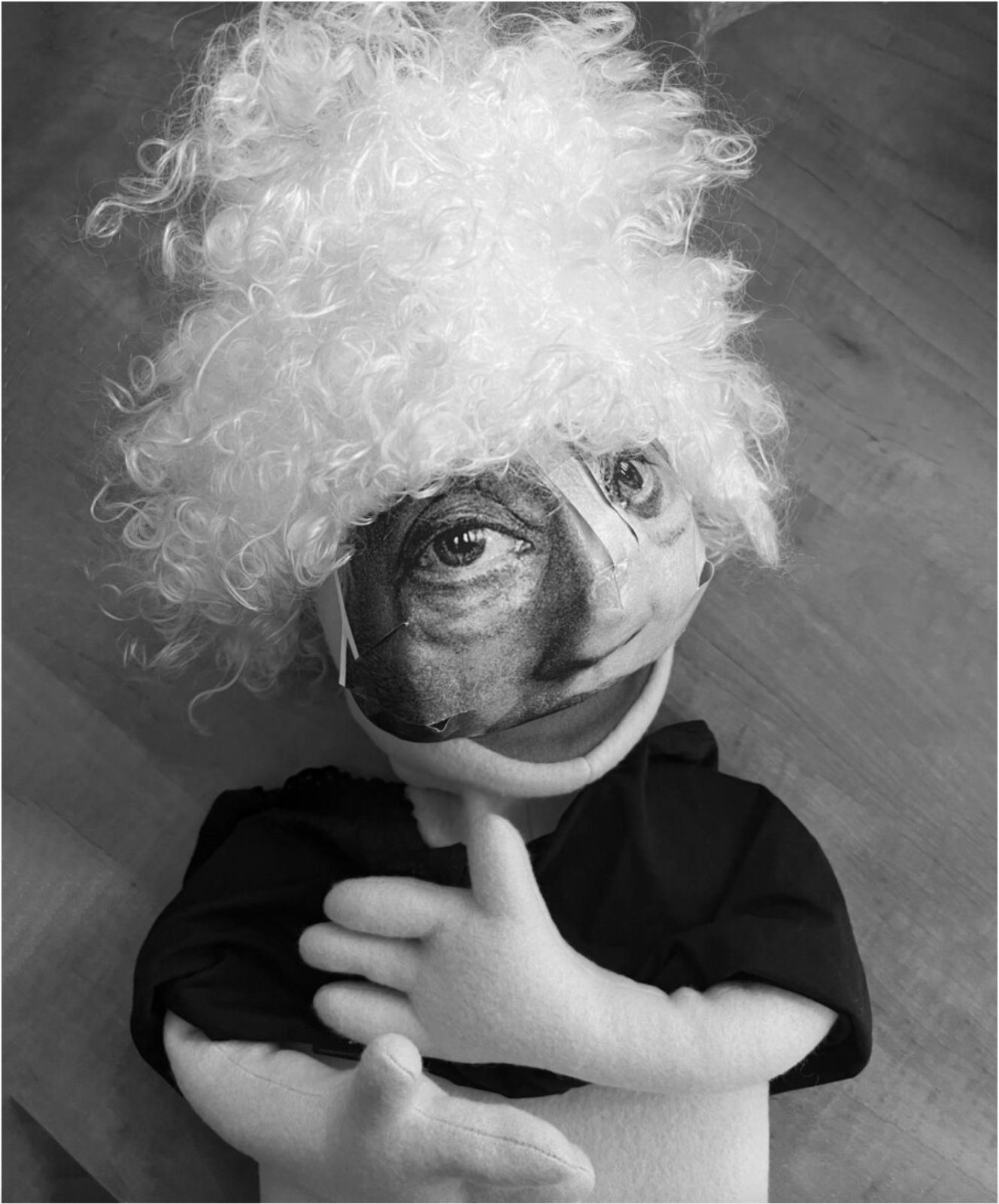
In the other works in the exhibition, the artist depicts herself and her siblings: her older sister and older brother during a holiday by the sea. Gustowska never appears alone; her “self” always requires an echo. She repeatedly places herself in relation to her sister, as in the early work Relative Similarities VIII – Surrogate Twinness from 1980. Following her sister’s death, this motif takes on a new form. In one of her most recent works, She and Me, Gustowska creates a double of herself, holding it in her arms like a living being. The motif of the self as divided and multiplied also appears in her self-portraits. The work Beyond Myself itself, shown here and dating from 1986, evokes a fragmented self.
One of the key works in the exhibition is Dinner Party, which was inspired by an archival photograph from the artist’s childhood. The photograph shows her sister with friends seated around a round table. Gustowska intervenes directly in this memory by adding a visual quotation from Judy Chicago’s famous installation The Dinner Party (1974–79): the place card dedicated to Virginia Woolf, which refers to the feminist project of commemorating and making visible significant women in history. In this way, the seemingly everyday scene acquires a new meaning: the private memory of life in the villa in Poznań becomes intertwined with Virginia Woolf’s call for “a room of one’s own” in A Room of One’s Own (1929) and Judy Chicago’s symbolic table of female community. At the same time, the scene can also be read as a kind of séance—a ritual of conjuring spirits, in which past and present enter into dialogue.
With the kind support of the Art Archive Foundation and Prater Galerie Berlin.